Thursday, December 28, 2006

OrganizedWisdom.com Makes the Wall Street Journal

I was thrilled to wake up yesterday to see Laura Landro's article in the Wall Street Journal titled, Social Networking Comes to Health Care (subscription required but this link should work for 7 days).
There are several important web communities featured in the article and OrganizedWisdom.com is listed in the following break out box as one of the new health sites adopting social-networking, custom search and new interactive technology.


Landro's article is a major trend piece about what's going on with online health care, and the validation and coverage from such an important news source is a great way for our company to enter 2007.

Since you may not have access to the WSJ, here are a few highlights:

The social-networking revolution is coming to health care, at the same time that new Internet technologies and software programs are making it easier than ever for consumers to find timely, personalized health information online. Patients who once connected mainly through email discussion groups and chat rooms are building more sophisticated virtual communities that enable them to share information about treatment and coping and build a personal network of friends. At the same time, traditional Web sites that once offered cumbersome pages of static data are developing blogs, podcasts, and customized search engines to deliver the most relevant and timely information on health topics.

The same technologies are making it possible for advocacy groups, government agencies and health-care providers to update consumers on relevant health news and deliver personalized health-awareness messages, reminders and alerts to email accounts, wireless devices and mobile phones. Online collaborations known as wikis, which let different users jointly work on Web-based information such as photo albums and contact lists, are developing to help communities plan for public-health emergencies, such as fluwikie.com, a flu-pandemic planning site. Mainstream advocacy groups and government agencies are offering their own specialized health-information "feeds" to consumers, and even experimenting with three-dimensional online computer worlds that use surrogates known as avatars to let visitors interact.


Landro continues...
While some sites don't offer all the bells and whistles of full-blown social networking sites, they are taking advantage of the phenomenon to reach out to special audiences. The Wellness Community, a nonprofit group that provides free support and education to cancer patients and families, launched a Web site, grouploop.org earlier this year to help teens with cancer connect in a private, safe environment. The group says it has reached more than 15% of the approximately 50,000 teen cancer survivors in the U.S., and is also connecting teens in nine other countries. In addition to weekly scheduled support groups moderated by a professional, teens can log in at any time of day to post or read messages in a password-protected site. A comprehensive search engine allows users to search for other teens with cancer on such criteria as age, location, or diagnosis.


We have big plans and many exciting new developments for OrganizedWisdom.com in 2007. Thank you all for your support helping us launch the company this year. Your contributions, feedback, and suggestions have been invaluable. Please keep checking in and sharing your personal health wisdom to help others!

Friday, December 22, 2006

Oasis!


Three More of Mark Cuban's Invaluable Business Rules

Mark Cuban's Blog Mavrick is always one of the first blogs I click to in my news reader. That's because he's always sharing such useful advice and wisdom that as an entrepreneur I find invaluable.

Like these 3 Lessons he details in his recent post about Success and Motivation:

1. Everyone is a genius in a bull market

2. Win the Battles you are in before you take on new battles.
Its a huge lesson for entrepreneurs. Win the battles you are in first, then worry about expansion internationally or into new businesses. You do not have unlimited time and/or attention. You may work 24 hours a day, but those 24 hours spent winning your core business will pay offer far more. It might cost you some longer term upside, but it will allow you to be the best business you can be. To use a sports metaphor, get the fundamentals right and then add to your fundamental skills before you try to take on the trick shots.

3. Few businesses only have one opportunity.
Every entrepreneur's mind goes crazy with the new and exciting things they can do beyond the new and exciting things they are already doing. The risk is that you can drown in all these opportunities. Far too often when an entrepreneur hits a rough patch or competitive challenge, the temptation is too "turn on the thinking cap" and find something new for the company to do. Don't fall to the temptation. As an entrepreneur you have to know what the core competencies of your business are and make sure that your company focuses on being the absolutely best it can be at executing them. Bottom line is this. If you are adding new things when your core businesses are struggling rather than facing the challenge, you are either running away or giving up. Rarely is either good for a business. In fact, by chasing these opportunities, you may be assuring that you drown in them.

These rules may seem like common sense to many business pros, but the reality is, it's useful to rethink/relearn/remember great lessons like this as frequently as possible and to ask yourself frequently: am I following these rules?

Sunday, December 03, 2006

Joe Apology Gets Some Press


My good friend Andy DiSimone launched a very interesting blog last March called JoeApology.com. It's a simple concept that packs a punch and is starting to get noticed. Take a look at what The Standard Report had to say about the site last week here in its article titled: Shh...I'm Sorry. Give him a hand by Digging the article by clicking here.

Congrats Andy!

Thursday, November 30, 2006

Is Web 3.0 Really About Technology?

I was a bit surprised by John Markoff's Nov. 11 piece on Web 3.0, or the "semantic Web" based on artificial intelligence (AI).

Surprised because Markoff, and those quoted in the article, are still talking about the Web in terms of technology, rather than human behavior. That is, is the Web really still about technology? To me that's like us talking about television, radio, or print in terms of black and white vs. color, frequency and watts, and types of printing presses. So I ask, is Web 3.0 really only about technology?

Since Markoff writes the technology column I guess I shouldn't be that surprised, but from what I am seeing take shape online, the emerging "Web 3.0" is something much more fundamental than the tools and platform running on the back end.

If Web 1.0 was millions of linked online brochures ("web sites"), Web 2.0 a more sophisticated version of applications mashed together ("mashups"), then I guess it makes sense that Web 3.0 could be about AI. But to me, I think what's more interesting is to define the innovation that is occurring online in terms of how this change is impacting human behavior. So in a Web 1.0 world, ordinary people got access to a networked world that was interactive, visual, and affordable. With Web 2.0, the impact of scale, collaboration, participation continues to impact pricing, information access, the job market, relationships, social interaction, our news media and so forth. So how will Web 3.0 change human behavior? How will people be impacted by the next wave of innovation and progress?

It seems to me that a Web 3.0 world, is about people/companies/organizations leveraging all of the great tools and infrastructure created from Web 1.0/2.0 and using it to develop things/products/services that actually make a difference in their lives and those in their community (where ever that community exists - online or off).

I believe Web 3.0 is about "nichification" and specialization. It is about harnessing all of this great innovation to develop things that people are actually interested in or that they actually need. Of course, this has been going on for many years already, but now it will go on in virtually every industry and for every idea imaginable. It's not about a cool new calendar application that features AJAX. It will be about a calendar that has meaning to my life and changes my behavior. What does that look like? I don't know...

Because people not only have the tools, capability and infrastructure to take control, they will do so in ways relevant to their lives, and not just because a computer told them so. But because nichification and specialization are now possible in a Web 3.0 world. While the technology may be getting better, what is really changing is how people are leveraging these new tools for change and progress. The question to me is not about the types of technologies running behind the Web, or how they are working, but rather what they are doing to help real people. And that is an exciting thing to be a part of...

Wednesday, November 29, 2006

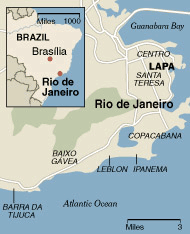
Lapa: Rio's Symbol of Samba (And My Favorite Neighborhood in Rio)


Finally, the mainstream media (see below) is starting to cover Lapa, an area in Rio de Janiero. For years I've been telling everyone I know in Rio, if I could buy a building anywhere in that magnificent city, it would be in Lapa. And for years, people from Rio have said that I'm crazy. It's too dangerous. And all sorts of other fear-filled exaggerations.

So when the The New York Times published a great article in the Travel section this week: In Lapa, Rio de Janiero, the Samba Never Stopped, I was both pleased and annoyed. Pleased because of the validation factor, but annoyed because I don't yet own a building in Lapa and I don't want to see too many people crowding such a great place before I get there!

With its magnificent and classic architecture, great musician and art scene, street characters, night life, and non-stop samba, don't listen to the guides who tell you to avoid this place. Go there straight away...

Why Not Give A Goat This Christmas?

Tired of giving people the same old stuff for Christmas? Want to share something meaningful and give back a little more this year? Here's an idea: give the gift of Kiva.

Kiva lets you connect with and loan money to unique small businesses in the developing world in small amounts (like $25). By choosing a business on Kiva.org, you can "sponsor a business" and help the world's working poor make great strides towards economic independence. Throughout the course of the loan (usually 6-12 months), you can receive email journal updates from the business you've sponsored. As loans are repaid, you get your loan money back.

There are all sorts of interesting entrepreneurs you can sponsor from helping farmers in Africa buy more chickens to helping a village raise enough money to buy more goats.

They even have gift certificates here.

Friday, November 17, 2006

Help Orny Beat K-Fed

The race is on...Click this link to watch the race between Orny Adams and K-Fed. Who's CD/DVD will sell more copies? K-Fed is already taking a nose dive in week four. Orny's making traction in his first week, which is great to see since he is doing 100% of the distribution himself and his marketing is all word of mouth.

Go Orny go.

Thursday, November 16, 2006

My Podcast Interview with The HealthCare Blog And Recent Speech to Pharma Marketers

Matthew Holt from The Health Care blog just posted his podcast interview with me and Daniel Palestrant, founder and CEO of Sermo.com. I really enjoyed the discussion, which was focused mainly on Health 2.0 issues and how our respective communities are growing. The transcript will also be posted soon, but for now you can take a listen to the interview.

In other OrganizedWisdom news, my partner Steven Krein and I just returned from a great two days at the eyeforpharma eCOmmunications and online marketing conference in Philadelphia. You can download the PDF of our speech here. We'll try to get the audio up soon as well...

Sunday, November 12, 2006

Path of Most Resistance

Orny Adams, my great friend (and former roommate over at Studio 95 on Horatio St.) has just released his first comedy CD/DVD: Path of Most Resistance. Once I get a few extra moments I'll be posting a podcast interview with Orny about what Path means to him. I'll blog more about this in the near future, but in the meantime I hope you will all buy a copy of Path and tell your friends to do the same...

Here's his site: www.ornyadams.com

Set List:

1. My Wife
2. Fat, My belt
3. Snuggles
4. Calvin Klein, Buddha
5. Eye Muscle
6. Vi-Quila, Chamomile Tea
7. Old People
8. Aspirin a Day, Bee Duck
9. My Hair
10. Propecia
11. Fat Kids
12. Sleeping
13. Phone Sex
14. Oversexualize
15. DVD Players in Car
16. Kids and Guns
17. News, Teacher/Student Sex
18. Bombs, 72 Virgins, DNA Evidence
19. Violent Adults, Shot Attorney, Galileo
20. Car Seats, Skidmark
21. “The Future”, Customer Service, Outsourcing
22. Staples, Seeing Eye Dog, Scale
23. We’re So Lazy, Socks
24. Chaplin, Projection, Agree to Disagree
25. Woman too Powerful
26. Checks and Woman
27. Female Vote
28. Cuban Girlfriend

Thursday, November 09, 2006

One needs to know but three words to play poker: call, raise or fold

I was intrigued by a reference Bill Maher made last night on Larry King Live to a compelling article (first published in an old edition of LA times - 9/17/05) from Glengarry Glen Ross author David Mamet.

You'll have to get the full article from the LA Times archives, but I have paraphrased some of the best parts below. While the article is about John Kerry and the democrats circa 2005, I consider the same concepts and ideas to be applicable to entrepreneurs, or how one goes about life in general.

Poker Party

By David Mamet

ONE NEEDS TO know but three words to play poker: call, raise or fold.
"In poker, one must have courage: the courage to bet, to back one's convictions, one's intuitions, one's understanding. There can be no victory without courage. The successful player must be willing to wager on likelihoods. Should he wait for absolutely risk-free certainty, he will win nothing, regardless of the cards he is dealt"

"The Democrats, similarly, in their quest for a strategy that would alienate no voters, have given away the store, and they have given away the country.

"Committed Democrats watched while Al Gore frittered away the sure-thing election of 2000. They watched, passively, while the Bush administration concocted a phony war; they, in the main, voted for the war knowing it was purposeless, out of fear of being thought weak. They then ran a candidate who refused to stand up to accusations of lack of patriotism.

The Republicans, like the perpetual raiser at the poker table, became increasingly bold as the Democrats signaled their absolute reluctance to seize the initiative."

"The American public chose Bush over Kerry in 2004. How, the undecided electorate rightly wondered, could one believe that Kerry would stand up for America when he could not stand up to Bush? A possible response to the Swift boat veterans would have been: "I served. He didn't. I didn't bring up the subject, but, if all George Bush has to show for his time in the Guard is a scrap of paper with some doodling on it, I say the man was a deserter."

This would have been a raise. Here the initiative has been seized, and the opponent must now fume and bluster and scream unfair. In combat, in politics, in poker, there is no certainty; there is only likelihood, and the likelihood is that aggression will prevail."

"One may sit at the poker table all night and never bet and still go home broke, having anted away one's stake.

The Democrats are anteing away their time at the table. They may be bold and risk defeat, or be passive and ensure it."